
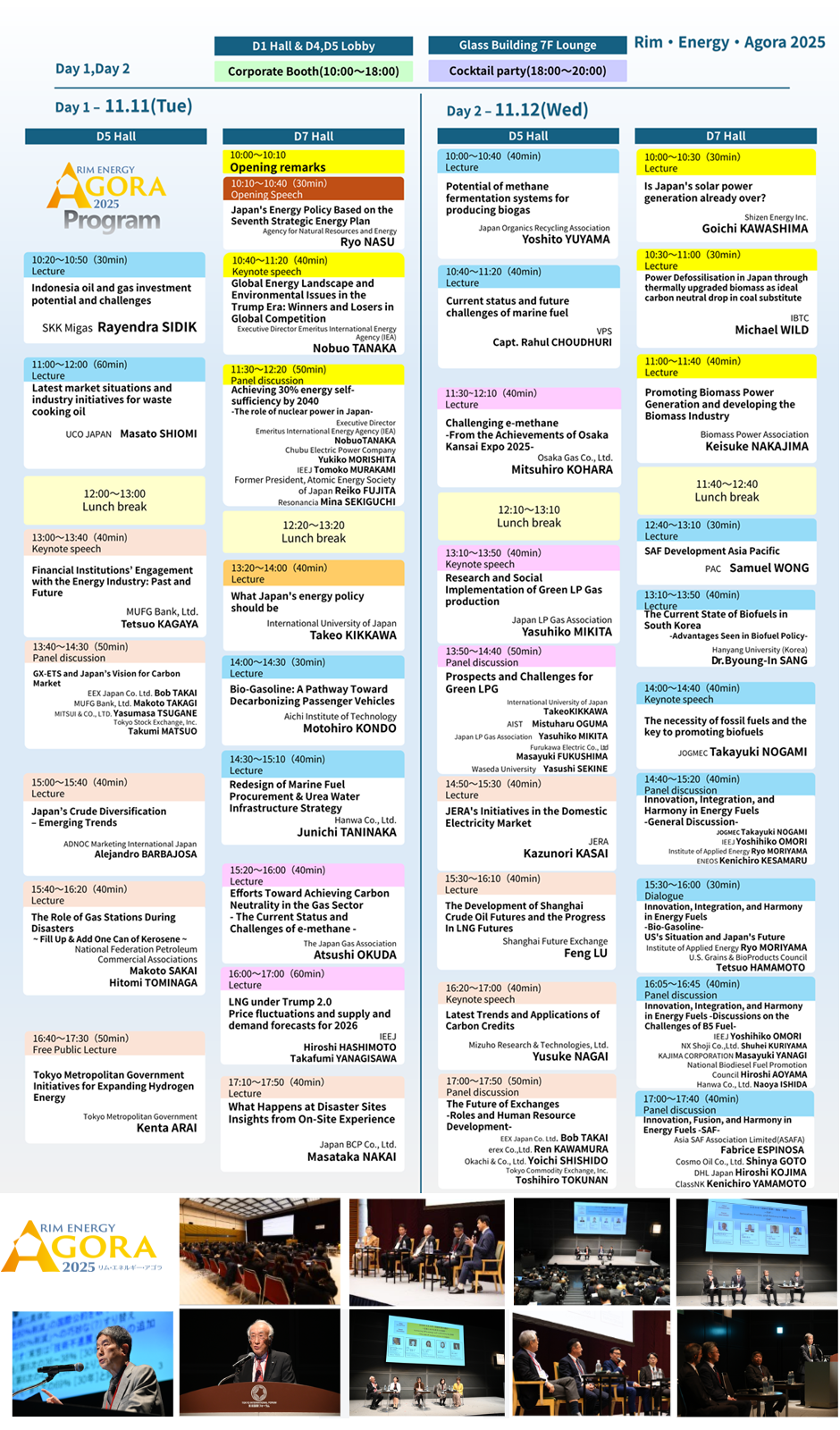
A presentation was given on the investment environment in Indonesia’s oil and gas upstream sector. After outlining the status of oil and gas fields currently under development as well as undeveloped fields, the speaker explained the role played by SKK Migas. The presentation also addressed the competitiveness of Indonesia’s upstream sector and provided an overview of the investment process and specific projects offering concrete investment opportunities.
Under the theme “New Energy Strategies Enabled by the Circular Economy,” a passionate presentation was given on the current status and future outlook of used cooking oil (UCO). As a key domestic challenge, the speaker highlighted the need to raise the household UCO collection rate from the current few percent to a target of over 10%. It was also stressed that establishing stringent quality standards for use in SAF and industrial feedstocks is an urgent priority. To this end, the importance of building voluntary inspection frameworks, standardizing analytical technologies, and ensuring quality assurance and traceability was strongly emphasized.
From the perspective of project finance, the presentation explained how the energy industry and financial institutions can work together to create value and address societal challenges. Citing MUFG’s financing track record in projects such as hydrogen and ammonia, SAF, CCS, and energy storage batteries, the speaker emphasized the Group’s commitment to contributing to sustainable environmental, social, and economic development.
With Phase 2 of the GX-ETS set to begin in April 2026 and the emissions trading system about to become fully operational, the session revisited the outline of the system. Discussions covered the realities of emissions allowance trading in Europe, which is a leading region in this field, as well as the role of financial institutions, which are essential to revitalizing the system. It was concluded that building a uniquely Japanese emissions trading system will require close collaboration between the public and private sectors.
A presentation was delivered on Japan’s crude oil import trends and IFAD Murban. In addition, changes in the global crude oil market influenced by U.S. tariff policies and sanctions on Russia were discussed. Five years after its listing, IFAD Murban has seen steady growth in trading volumes. It was also noted that demand centers in Japan and across Asia regard Middle Eastern crude oil, including Abu Dhabi grades, as the most stable source of supply.
The role of gas stations during disasters was highlighted through examples of fuel supply during the Great Hanshin-Awaji Earthquake, the Great East Japan Earthquake, and the Noto Peninsula Earthquake. Gas stations were emphasized as the “last line of defense,” responding to requests for fuel supply to evacuation centers, core hospitals, and mobile power supply vehicles. The importance of preparedness was also stressed, encouraging the public to keep vehicle fuel tanks full and to store an extra can of kerosene for emergencies. As part of outreach efforts, a dance performance by the industry’s first idol unit, “Full-Charge,” was also showcased.
The metropolitan government’s initiatives to expand the adoption of hydrogen energy were explained. Presentations covered the development of hydrogen refueling stations, the deployment of fuel cell buses, and related support frameworks. As of the end of fiscal year 2024, a total of 135 fuel cell buses—including those operated by private entities—were in service in Tokyo, with a target of reaching 300 buses by the end of fiscal year 2030. The metropolitan government emphasized that it would continue to actively invest in “producing,” “transporting,” and “using” hydrogen in order to realize a hydrogen-based society.
Based on the Seventh Strategic Energy Plan, a presentation was delivered on global energy trends and Japan’s energy strategy. The session was structured into three parts: changes in the energy landscape and the background to ongoing debates, global trends toward decarbonization, and initiatives looking ahead to 2040. Government policies were explained in detail, with an emphasis on maximizing the use of power sources—such as renewable energy and nuclear power—that contribute to energy security while offering significant decarbonization benefits.
The presentation explained how U.S. President Trump has sought to strengthen global influence by leveraging energy in coordination with Russia and Saudi Arabia, while China, India, and Europe are enhancing national security by promoting the adoption of renewable energy. It argued that Japan should cooperate with other Asian countries, including South Korea, while making effective use of its nuclear technology.
Female experts with long-standing experience in the nuclear field offered a sharp critique of issues facing Japan’s nuclear industry, including the so-called “nuclear village” problem. The discussion covered the background to Chubu Electric Power’s investment in small modular reactors (SMRs) in the United States, the shortage of technically trained personnel in the nuclear policy decision-making process, the importance of reducing radioactive waste, and the need to reconsider nuclear power as social infrastructure—particularly at a time when female catalysts are emerging in the political arena.
The presentation organized the challenges facing Japan’s current energy policy and explained the policy shifts and issues that emerge from an analysis of the Seventh Strategic Energy Plan. It argued that, in pursuing carbon neutrality, the key to addressing the greatest challenge—reducing energy costs—lies in making full and effective use of existing infrastructure, presenting this approach as a distinctly Japanese pathway that Japan can demonstrate to the world.
Under the theme “Toward the Introduction and Wider Adoption of Bioethanol-Blended Gasoline,” the presentation explained fuel diversification in the automotive and transportation industries. Based on the government’s policy framework for next-generation fuels, it clearly outlined the mechanisms, standards, and future direction of bioethanol-blended gasoline, which is attracting growing attention. Emphasizing the belief that “environmental technologies only contribute to the environment once they are widely adopted,” the speaker highlighted the importance of pricing strategies, tax systems, and securing feedstock supplies.
From the perspective of a trading company operating a global bunker oil business, the presentation explained the expanding use of biofuels driven by stricter IMO regulations, growing demand across land, sea, and air transportation, challenges in feedstock supply, and future procurement strategies. In the latter half, it covered the basics of urea solution required for denitrification systems (SCR systems), the background behind supply uncertainties, delivery methods, and measures to ensure stable supply.
Based on global energy trends and Japan’s energy policy, the presentation explained the production and social implementation of e-methane as a means of achieving carbon neutrality in city gas. Toward the target of replacing 1% of city gas supply with e-methane by fiscal year 2030, it introduced innovative methanation technology development being advanced by major city gas companies, as well as the use of clean gas certificates.
The presentation explained how U.S. LNG strategy has changed significantly following President Trump’s inauguration. With the government backing LNG-related companies, exports from the United States are expected to increase going forward. It was emphasized that pricing is increasingly influenced by gas-on-gas (GOG) competition. From a medium-term perspective, progress in final investment decisions (FID) was identified as a key factor.
An explanation was given of little-known real-world experiences in emergency response. During major earthquakes, large-scale power outages, typhoons, heavy snowfall, and other natural disasters, fuel was supplied directly to sites where refiners and trading companies were unable to operate. The presentation described actual emergency responses, such as delivering fuel to areas inaccessible due to fallen trees or landslides caused by typhoons, and refueling vehicles stranded by heavy snow. In response to the increasing frequency of natural disasters, new technologies were also showcased, including the deployment of disaster-response vehicles and the use of drones.
The potential of methane fermentation systems for producing biogas was highlighted. The presentation explained national policies, future visions, and initiatives being undertaken by local governments. It emphasized that biogas produced through methane fermentation systems could serve as a starting point for creating various forms of domestically sourced energy. Advocating a shift from conventional fuels, the speaker called for the development of energy-self-sufficient agriculture and rural communities within a locally produced and locally consumed, circular regional ecosystem. The session concluded with a passionate performance of an encouragement song.
Reported trends in off-spec marine fuels identified through fuel analysis were presented, with concrete examples illustrating the adverse effects of catalyst fines on engine performance. For biofuels, whose use is expanding, fuel property trends were analyzed in detail from the perspective of feedstock characteristics. The session also covered standards for methanol bunkering, which is expected to see wider adoption, and introduced VPS Emsy, an efficient emissions monitoring system designed to support decarbonization efforts.
The company introduced its latest technological developments aimed at achieving carbon neutrality, including the production and supply of e-methane demonstrated at the Osaka–Kansai Expo. The presentation detailed the advantages of e-methane, such as its ability to use existing supply chains without modification and to be blended with natural gas. The company’s advanced initiatives—offering a full range of options including energy storage batteries, hydrogen, and ammonia—drew strong interest from the audience, and a long line of attendees formed to greet the speakers after the session.
The presentation outlined how LP gas is positioned within Japan’s energy policy and introduced ongoing public–private initiatives to develop production technologies for green LP gas. It covered research and demonstration projects led by the University of Kitakyushu and NEDO, as well as the latest global trends in decarbonization. Based on these developments, the session summarized the challenges and prospects for the social implementation of green LP gas.
A panel discussion was held with Mr. Kikkawa, the president of International University, who serves as chair of the public–private study group on green LP gas, acting as moderator, together with engineers and academic experts directly engaged in the development of production technologies. The discussion addressed the key points of each R&D effort, challenges to be overcome, issues to be examined toward social implementation, as well as the frameworks and policy measures needed that are difficult to realize through self-help efforts alone.
The company introduced its initiatives as an energy enterprise that owns the entire value chain, from fuel procurement and power generation to the wholesale supply of electricity and gas. In recent years, it has also focused on clean energy by combining renewable energy with low-carbon thermal power. From April 2025, JERA GM began trading operations that integrate coal, LNG, and electricity in Japan, strengthening its framework for managing market risks.
A presentation was given on the overview of China’s futures markets. It explained recent developments, noting that crude oil futures trading on the Shanghai Futures Exchange has grown to become the world’s third-largest crude oil futures market. The speaker also addressed the physical delivery mechanisms by crude grade. In addition, a presentation was delivered on global natural gas futures markets, emphasizing the importance of Asia—particularly China—in global LNG trading.
The session began with an explanation of the mechanisms and classifications of credits, followed by examples of concrete corporate initiatives. These included investments in forests and mangrove restoration projects aimed at achieving carbon neutrality. In addition, in light of the launch of Phase 2 of the GX-ETS in fiscal year 2026 in Japan, an overview of the J-Credit scheme was provided, covering its framework, current supply levels, and usage trends. The session concluded with the speaker’s personal views on the future outlook for fuels and credits.
The session began with a discussion on why, even within domestic commodity markets, some markets—such as electricity—are thriving, while others, including oil and LNG, currently lack momentum. Participants shared their respective views and opinions on the factors behind these differences.
Next, attention turned to credit risks inherent in markets, referencing recent cases of bankruptcies among new power retailers. Explanations were given on why such credit risks arise, how they can be mitigated, and how credit risk is addressed in futures trading.
Finally, as the electricity market continues to expand, the discussion highlighted the growing need for human resource development amid increasing labor mobility. Speakers shared their approaches to talent development as well as perspectives on career building for younger generations.
The presentation reviewed the historical development of solar power generation, its rapid expansion in Japan under the FIT scheme, and the subsequent emergence of opposition movements, before organizing the factors behind the current stagnation in new projects. It also examined how solar power in Japan should move forward from the perspectives of government targets and energy security.
The presentation described how torrefaction technology has been refined and made more efficient over many years, positioning biocarbon as one of the easiest and most cost-effective alternatives to fossil coal. Taking into account the growing demand in energy and industrial applications, as well as the rapid expansion of technology providers and large-scale plant projects, the session examined prospects for future development.
As an industry association established primarily by power generation companies, the presentation explained the significance of biomass power generation, the current state of Japan’s power generation sector, fuel procurement practices, and its societal role. It highlighted the unique strengths of biomass power—such as its excellent supply/demand balancing capability among renewable energy sources, effective use of existing infrastructure, and potential to achieve negative emissions—and conveyed the importance of expanding its deployment.
The presentation explained the growing demand for decarbonization in the aviation industry and its future outlook. The core themes included regulatory frameworks for achieving carbon neutrality in aviation, technical challenges, measurement and certification systems, and the current situation and prospects in Asia—particularly in Japan and South Korea. It highlighted the strengthening of SAF usage obligations from 2027 onward under ICAO’s COSIA certification and the resulting need for airlines to further expand SAF adoption. It was also noted that technology solutions provided by specialized companies such as PAC contribute to the sustainability of the industry.
The presentation highlighted and explained South Korea’s strategies for energy transition and decarbonization toward 2050, emphasizing concrete plans for expanding renewable energy, strengthening energy infrastructure, promoting the adoption of electric vehicles (EVs), and decarbonizing industry. It explained that the government has formulated a wide range of policies to reduce carbon emissions and aims to build a sustainable energy future through measures such as economic diversification and workforce reskilling programs.
The presentation reviewed global demand outlooks for oil and natural gas presented by international organizations and major oil companies, noting projections that demand for fossil fuels would continue to rise or decline only slightly toward 2050. It emphasized that expanding renewable energy was essential to addressing global environmental challenges. The session also explained the current state of biofuels, whose demand was increasing in recent years.
ASAFA, Cosmo Oil, DHL Japan, and ClassNK (Nippon Kaiji Kyokai) presented their respective initiatives to promote the adoption of sustainable aviation fuel (SAF).
Cosmo Oil outlined its efforts to produce and supply SAF, DHL Japan introduced the use of SAF in logistics operations and its CO₂ emissions reduction measures, and ClassNK explained its certification schemes. From the perspectives of safety, environmental performance, and market penetration, the speakers shared the latest developments in advancing the practical application of SAF and discussed concrete strategies toward its commercialization.
Building on the general discussion, a focused dialogue on biogasoline was held between a next-generation fuels expert and a grain specialist. The discussion examined the production and distribution of corn used as ethanol feedstock, and identified key differences between the United States—where ethanol-blended gasoline is widely marketed—and Japan, which aims to promote its introduction going forward. In Japan, sales of gasoline blended with 10% ethanol are expected to expand from the second half of 2028.
Discussions were held among a trading company handling biodiesel as a next-generation fuel, end users that consume it, and an administrative body promoting its adoption, focusing on current challenges and future policy directions. The discussions offered insightful perspectives on how end users view the need for CO₂ reduction and on trends among trading companies supplying the fuel. Differences from conventional fuels—such as those related to tax treatment and regulatory frameworks currently under consideration—along with industry responses, were also identified as key issues to be addressed.
ASAFA, Cosmo Oil, DHL Japan, and ClassNK (Nippon Kaiji Kyokai) presented their respective initiatives to promote the adoption of sustainable aviation fuel (SAF).
Cosmo Oil outlined its efforts to produce and supply SAF, DHL Japan introduced the use of SAF in logistics operations and its CO₂ emissions reduction measures, and ClassNK explained its certification schemes. From the perspectives of safety, environmental performance, and market penetration, the speakers shared the latest developments in advancing the practical application of SAF and discussed concrete strategies toward its commercialization.